
Build vs Buy Software: Which Saves More Money in 2026?
If your organization is considering acquiring new software, you've likely asked yourself: should we develop our own or buy an existing one?
At first glance, buying software might seem more affordable — a monthly subscription often feels less intimidating than a six-figure development project. However, cost isn't the only factor to consider. The real question isn't “Which option costs less now?” but rather, “Which offers the best value over the next five years?”
Often, organizations end up spending more time and resources trying to adapt their workflows to software that doesn't fully fit their needs, rather than choosing the right solution from the start. The goal isn't to build every part but to make the smartest long-term investment.
The Difference Between Building and Buying Software
Buying software involves selecting an existing solution that caters to thousands of businesses, such as Salesforce, HubSpot, QuickBooks, and Monday.com. These products address common business challenges. In contrast, building software means developing a custom solution tailored to your company's unique workflows, processes, and goals. Neither option is inherently better; the best choice depends on your specific business needs.
When Buying Software Makes Sense
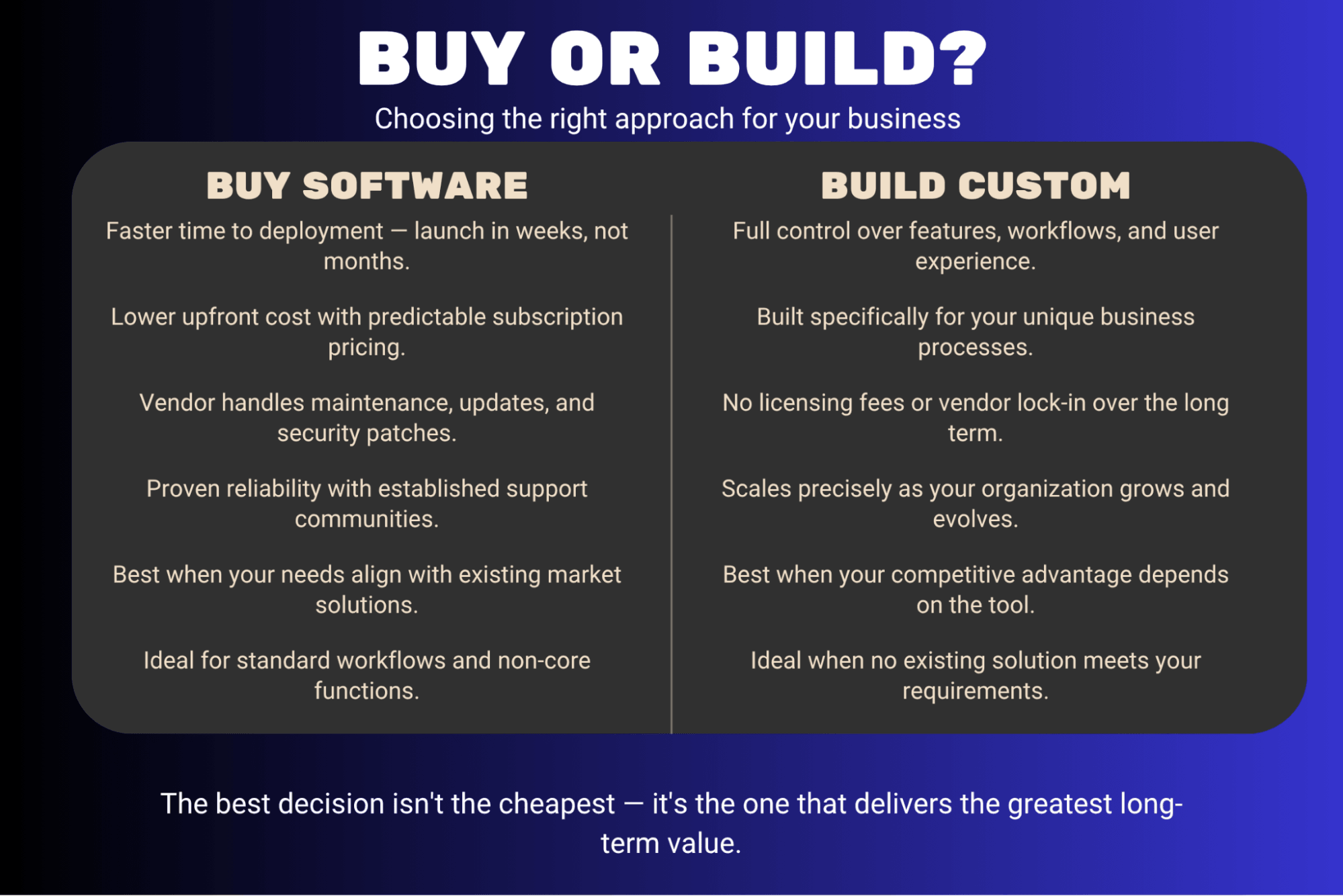
Purchasing software is frequently the most suitable decision when:
- Your procedures are relatively routine
- You require a solution promptly
- Your budget is constrained
- Your enterprise is still in the process of validating its operations
- Gaining a competitive advantage does not rely on proprietary software
For numerous startups and small enterprises, SaaS represents an ideal initial approach.
When Building Software Makes Sense
Custom software becomes essential when your business reaches a point where current tools start hindering progress. Indicators include:
- Employees manually transferring data
- Multiple subscriptions replacing a unified workflow
- Heavy reliance on spreadsheets
- Repetitive manual tasks
- Customer workflows that existing software can't handle
Gaining a competitive edge depends on operational efficiency. At this stage, software shifts from being merely an expense to becoming critical infrastructure. For a deeper look at what that investment actually costs, see our guide on custom software pricing in 2026.
The Hidden Cost of Buying Software
Subscription pricing often doesn't reveal the complete picture. Many businesses overlook expenses such as:
- Employee training
- Implementation
- Workflow workarounds
- Integration challenges
- Multiple software licenses
- Manual data entry
- Vendor lock-in
While these costs appear minor individually, they can add up over the years to surpass the initial subscription fee.
The Hidden Cost of Building Software
Custom software carries certain risks that businesses need to consider, such as higher initial costs, discovery and planning phases, development timelines, ongoing maintenance, infrastructure, security, and product ownership. Developing software just because it's possible seldom provides a strong return, whereas building software to address a specific, measurable business problem often yields better results.
Comparing Total Cost of Ownership
| Factor | Buy Software | Build Software |
|---|---|---|
| Upfront Cost | Low | High |
| Monthly Cost | Ongoing subscriptions | Maintenance & hosting |
| Customization | Limited | Complete |
| Scalability | Vendor-dependent | Designed for your needs |
| Integrations | Varies | Purpose-built |
| Competitive Advantage | Shared with competitors | Unique to your business |
| Ownership | Vendor owns platform | Your business owns it |
AI Is Changing the Equation
AI has transformed the economics of software development. Development cycles are accelerating, with prototyping now taking days instead of weeks. Automation minimizes repetitive engineering tasks. However, this doesn't imply that every company must develop software. Instead, it signifies that custom software is now more attainable than ever. The question has shifted from “Can we afford custom software?” to “Will custom software deliver greater value than opting for another SaaS subscription?”
A Simple Decision Framework
Buy software if:
- Your workflow is standard
- You need speed
- Customization isn't critical
- Budget is your primary constraint
Build software if:
- Your processes create competitive advantage
- Existing software creates friction
- Teams spend significant time on manual work
- Long-term efficiency matters more than short-term cost
Our Perspective
At Working Software, we don't jump straight to suggesting custom solutions. Sometimes, purchasing software is the best choice. Other times, companies have outgrown their current tools and require custom software tailored to their operations. The key is to understand the workflow first. Technology should adapt to the business, not the reverse. That's why our initial discussions rarely focus on features; instead, we explore how work is currently performed and identify areas of unnecessary friction. Only after this analysis do we advise whether building or buying software is the most appropriate option.
Frequently Asked Questions
Is buying software always cheaper?
Not necessarily. Subscription fees, implementation, training, integrations, and operational inefficiencies can significantly increase the long-term cost of ownership.
When should a business build custom software?
Typically when existing software limits growth, creates operational bottlenecks, or cannot support unique business workflows.
Can AI make custom software more affordable?
AI can accelerate development and reduce engineering effort, but successful software still requires thoughtful planning, architecture, and implementation.
Should startups build software immediately?
Usually not. Many startups benefit from validating their business with existing SaaS tools before investing in custom development.
Final Thoughts
The decision to 'build' versus 'buy' is fundamentally a strategic consideration rather than merely a technical one. Procuring software can facilitate rapid deployment, whereas developing bespoke solutions can establish a durable competitive edge. The optimal choice should not be based solely on initial expenditure but on the potential for delivering maximum long-term value to your organization.
Prior to selecting a particular solution, it is advisable to thoroughly assess your workflows, operational challenges, and growth objectives. An effective technology strategy begins with a clear understanding of the underlying problems you aim to address, rather than focusing solely on the software options available.