

How Much Does Custom Software Cost in 2026? (The Complete Guide)
Are you researching custom software prices in 2026? Chances are you've already discovered the same frustrating answers on the internet: “It depends.”
While that's technically true, it isn't very helpful when you're on a budget and haven't yet fully decided whether custom software is the right investment for your business.
The reality is that today, custom software can cost anywhere from $25,000 to well over $500,000, depending on what you're building, the complexity of the system, and how much integration or automation is involved.
But what many pricing guides tend to overlook is that the highest cost isn't found in the building of the software itself, but in the building of the wrong software that does nothing for your business.
At Working Software, we believe that successful software projects start by first understanding how your business operates, not by jumping straight into the development stage. When the right problems are identified, companies spend less, build and deploy faster, save more, and achieve a much higher return on investment.
In this guide, we'll break down what drives custom software costs in 2026, typical pricing ranges, where businesses overspend, and how to make smarter investment decisions for your business.
What Determines the Cost of Custom Software?
Unlike off-the-shelf software, custom software is designed specifically around your business processes and needs. Several factors influence the final investment.
Project complexity
For instance, building an internal operations dashboard of a door manufacturing company is very different from building an AI-powered logistics platform. A project's complexity is unique to the company and can significantly increase development time, testing, infrastructure requirements, and ongoing maintenance.
Number of features
A common misconception with software tools is that more features don't always create more value. One mistake many businesses make is trying to build everything at once. The most successful projects usually begin with a focused Minimum Viable Product (MVP) that solves one meaningful business problem before expanding.
Integrations
One of the biggest cost drivers is integration. Does your software need to connect with Salesforce, HubSpot, Stripe, QuickBooks, or internal systems?
No matter the number of integrations needed for your company, it requires planning, testing, and long-term maintenance.
User roles and permissions
Software used by five internal employees has different requirements than software supporting thousands of customers. Authentication, security, permissions, and scalability all influence cost.
AI capabilities
Adding AI isn't as simple as calling an API. Businesses often need workflow redesign, data preparation, prompt engineering, evaluation systems, security reviews, and monitoring. Most of the time, AI reduces costs; sometimes it increases them. The right answer depends on whether AI genuinely improves the workflow and solves a real problem for the company. AI can help build software faster, but it can't tell you whether you're building the right software.
Typical Custom Software Cost in 2026
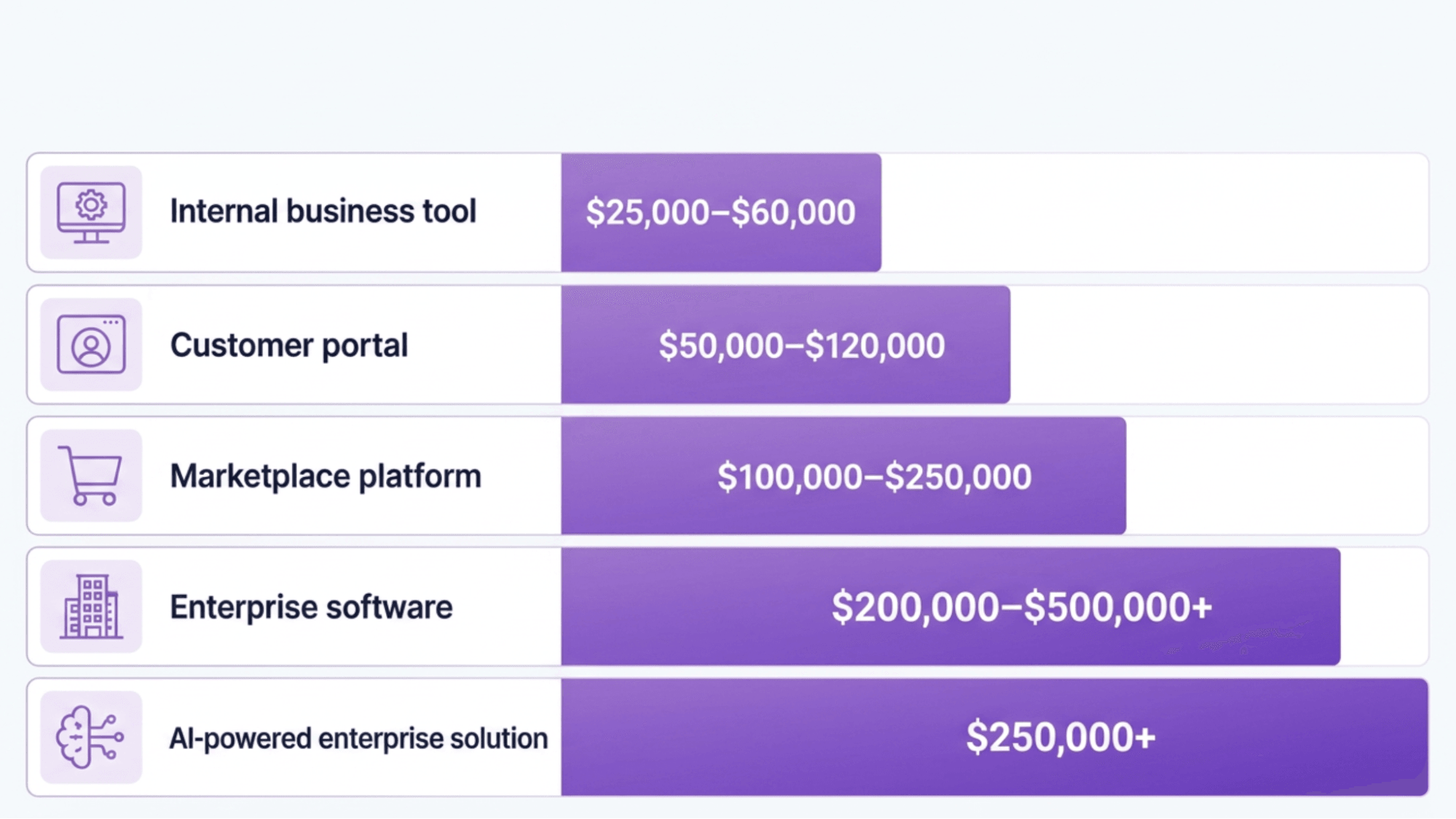
| Project Type | Estimated Cost (USD) |
|---|---|
| Internal business tool | $25,000–$60,000 |
| Customer portal | $50,000–$120,000 |
| Marketplace platform | $100,000–$250,000 |
| Enterprise software | $200,000–$500,000+ |
| AI-powered enterprise solution | $250,000+ |
These offer broad estimates of how custom software costs. Final pricing depends on project scope, integrations, security requirements, and ongoing support.
Why Some Software Projects Cost More Than They Should
A common misconception in software development is that coding is the most costly phase. However, that's often not the case. The true expense lies in creating features no one uses. We've seen organizations invest months in developing seldom-used functionality while overlooking operational issues that could deliver quick business benefits. Therefore, we always begin by understanding existing workflows before talking about the technology. The goal of software is to simplify work, not complicate it.
Is Custom Software Worth the Investment?
For many businesses, the real comparison isn't “How much does custom software cost?” but “How much is our current process costing us?”
When employees spend hours weekly on manual data transfers, report calculations, or routine tasks, these inefficiencies accumulate. Implementing the right software can cut operational costs, enhance accuracy, and allow teams to concentrate on more valuable work. If you're weighing this against an existing tool, our guide on build vs. buy software walks through the decision framework in more detail.
How AI Is Changing Software Development Costs
Artificial Intelligence is expediting the development process. However, increased speed does not inherently equate to reduced project costs. Successful software development continues to necessitate:
- A comprehensive understanding of business objectives
- Designing efficient workflows
- Making informed architectural decisions
- Conducting thorough testing
- Ensuring security
- Implementing continuous improvements
While AI enhances implementation speed, it does not substitute for meticulous product design.
How Working Software Approaches Custom Development
At Working Software, we start not with a list of features but by comprehending your current business operations. We ask questions such as: Where do teams waste time? Which manual tasks hinder growth? What repetitive activities can be automated? Which systems need to integrate? Only after understanding these workflows do we suggest appropriate software solutions. This method ensures businesses invest in software that provides tangible operational improvements and verifiable outcomes instead of adding unnecessary complexity.
Frequently Asked Questions
Why is custom software more expensive than SaaS?
Because it is tailored specifically to your business instead of being made for thousands of customers.
Can AI reduce software development costs?
Yes, but mainly by speeding up development tasks. Success still relies on effective planning and careful system design.
How long does custom software take to build?
Project timelines vary based on complexity, but many MVPs take several months, while enterprise platforms can take significantly longer.
Should I build an MVP first?
In many cases, yes. Starting with a focused MVP helps validate ideas, reduce risk, and prioritize features based on real user feedback.
Final Thoughts
Custom software represents a substantial investment; however, it can also serve as one of your most significant competitive advantages when developed in alignment with the appropriate business challenges. The objective is not to develop the most software, but rather to create software that generates the highest value.
If you are contemplating a custom software project in 2026, it is advisable to begin by thoroughly understanding your workflows before selecting the technology. The companies achieving the highest returns on custom software are not always the ones that spend the most. Instead, they focus on solving the right problem first. This should be the starting point for every successful software project.