
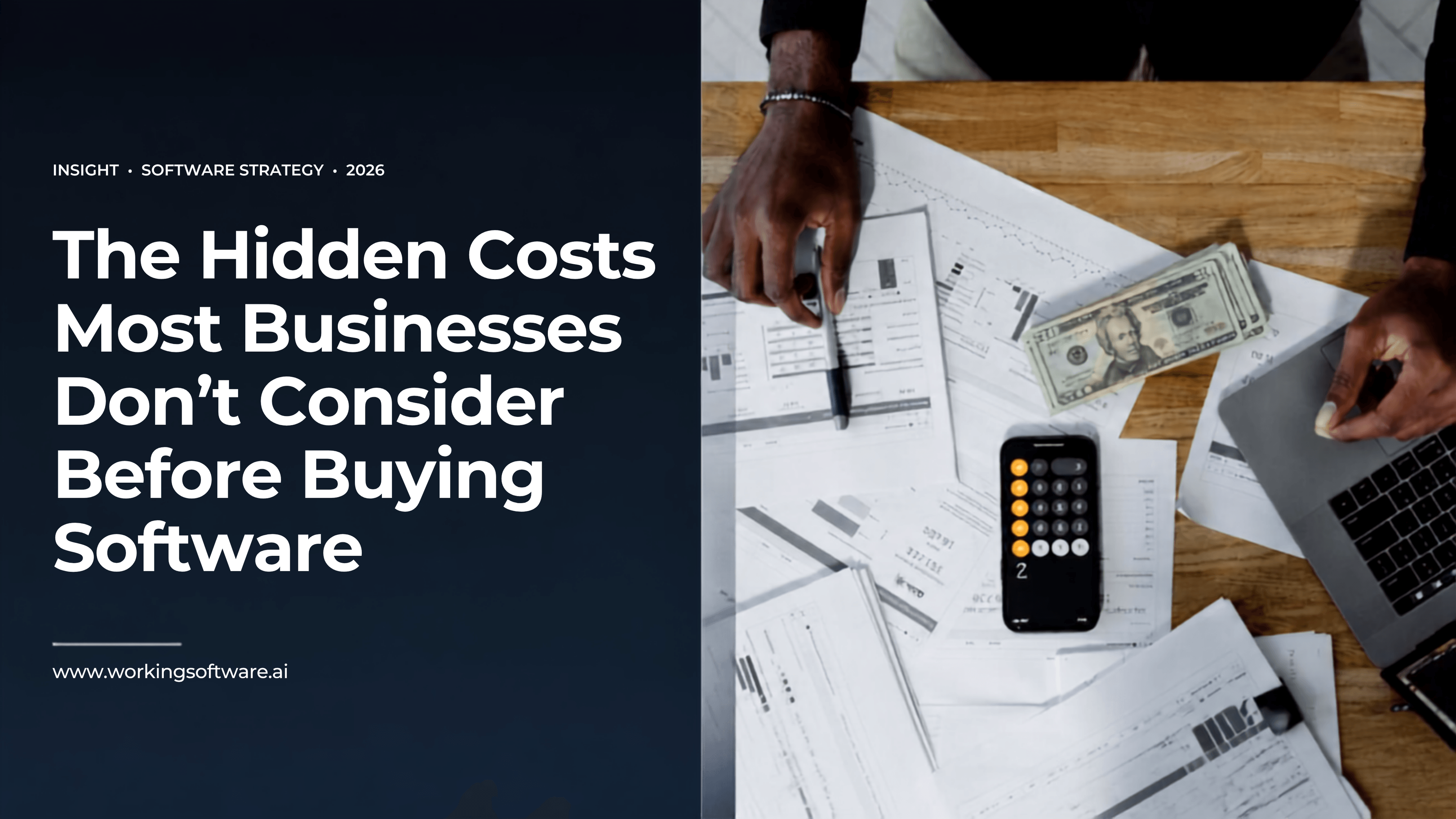
The Hidden Costs of Business Software Most Companies Overlook
The pricing listed on a software provider's website rarely corresponds to the actual expenditure incurred. Many organizations focus solely on subscription fees, often neglecting supplementary costs that arise post-implementation.
Such hidden expenses can subtly elevate operational costs, diminish productivity, and complicate the process of transitioning to alternative platforms more than anticipated. Before selecting your next software solution, every enterprise should consider these six costs.
1. Licensing Fees
Numerous platforms initially offer appealing entry-level pricing; however, as your business expands, the charges escalate considerably. As the number of employees requiring access increases, the costs associated with your software typically rise in tandem with your personnel count.
2. User-Based Pricing
Certain platforms impose charges for each additional user. What initially appears as an affordable monthly subscription may rapidly become one of your most substantial recurring operational costs as your team grows.
3. Integration Costs
Very few enterprises depend solely on a single software platform. Integrating CRMs, accounting software, communication tools, and operational systems typically requires supplementary software, additional implementation time, or custom development. These expenses are often neglected during the purchasing decision.
4. Customization Expenses
Pre-packaged software solutions are not tailored to the specific requirements of your enterprise. As your operational processes become increasingly specialized, it becomes necessary to invest in custom workflows, additional modules, or external consultancy services to modify the software to meet your organizational needs.
5. Maintenance and Support
Software continues to evolve beyond the initial implementation phase. Updates, security patches, technical support, employee training, and ongoing optimization necessitate time and resources, which should be accounted for within your long-term budget.
6. Vendor Lock-In
Perhaps the most frequently underestimated expense is reliance on a single vendor. The greater your business's dependence on one platform, the more challenging — and costly — it becomes to transition to an alternative solution. The process of switching providers typically entails data migration, employee retraining, workflow redesign, and operational downtime.
Final Thoughts
Selecting software involves more than merely identifying the lowest monthly subscription fee. It requires comprehending the total cost of ownership over the system's lifespan. Optimal technology choices are not solely determined by price; rather, they are predicated on long-term value, operational efficiency, and the software's ability to support your business's operational workflows effectively.
If you are weighing these costs against the alternative, our guide on build vs buy software walks through the full comparison.